

Most club swimmers don’t need a junior tech suit until they’re racing at state or regional level, and your child’s coach is the best person to say when that point arrives. Until then, a well-fitting training suit does the job. This guide covers when a tech suit makes sense, what you’re paying for, how to size for a growing swimmer, and how to make one last.
The short answer: Ask the coach first. Most kids are better served by a second good training suit until they qualify for bigger meets.
- Wait for the coach’s advice. It usually isn’t needed before state or regional championships.
- Check your swimming association’s and meet’s rules on suits for junior age groups before you buy.
- Size for race fit now, not for growth. A loose tech suit loses its purpose.
- Rinse in cold fresh water, never wring, and dry flat in the shade.
- If a tech suit isn’t needed yet, a chlorine-resistant training suit is the sensible spend.
Prices are in AUD, tracked daily from Australian retailers and shown as at the last update; check the retailer for the final price. Some links may earn us a commission at no cost to you. How we make money.
Does your child actually need a tech suit?
A tech suit is a compressive racing suit worn for competition only. It helps an already efficient swimmer hold their body position and reduces drag a little. It does not fix technique, and it won’t turn a developing swimmer into a finalist.
For most club kids, the first tech suit makes sense when they’re qualifying for state, regional or national-level meets. That’s where small margins decide places and the swimmer has the skills to benefit. At club nights and early carnivals, a training suit is fine, and plenty of coaches prefer it.
Talk to the coach before you spend anything. They know your child’s stroke, their meet calendar and whether the squad has a view on when racing suits come in.
Who should skip a tech suit for now
Skip it if your child swims mainly at club level, is still learning race skills like starts and turns, or is in a growth spurt. Skip it too if they find tight suits uncomfortable. A swimmer who’s miserable getting into a suit before a race isn’t helped by it.
Rules for junior age groups
Racing suits at higher-level meets generally need to be on the World Aquatics approved list. Approved suits follow set rules on coverage, materials and construction, and an approved suit carries a mark showing it’s on the list. Check the current World Aquatics list for the exact model if approval matters for your meet.
Some swimming associations also set their own rules for younger age groups, which can limit or ban tech suits at certain ages or meets. These rules vary and change over time, so don’t rely on what another parent tells you. Check your state association’s current rules and the specific meet information before race day.
The cost reality
A junior tech suit costs several times what a training suit does. See the table below for current prices at our retailers. Kids grow, so a suit that fits in autumn may be too short in the body by the following season.
It’s also a race-only item. Compression fabric loses its grip with use, so a suit worn at every training session wears out fast. If you buy one, budget for it to cover a season or a set of key meets, not years.
Check the returns terms before buying. The retailer listings for the Speedo Fastskin suits below say they can’t be returned because of their technical nature, and they recommend a fitting with a specialist retailer.
How a junior tech suit differs from a training suit
A training suit is built to survive chlorine and daily laps. It’s usually a single layer, with a cut that gives full shoulder movement and enough stretch to get on easily. The fabric is chosen for durability, not compression.
A tech suit uses firmer, compressive fabric, often with bonded or double-layered panels to support the hips and legs. Girls’ suits are usually a kneeskin (shoulders to just above the knee). Boys’ racing suits are jammers (waist to knee). They take longer to get on, feel tight on land and are meant for a few races at a time.
For a broader look at what’s available, browse our racing suits section.
Junior girls kneeskin
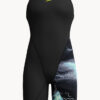
This is a girls’ kneeskin in a 75% nylon and 25% spandex compressive woven fabric, with an open back for shoulder movement and fixed straps. The retailer listing describes moderate compression, leg grippers and bonded dual-layer inner panels, and says it’s FINA (now World Aquatics) approved. It suits girls racing at state or regional level who have had a fitting and whose coach recommends a racing suit. Skip it if your daughter is still growing quickly or racing mostly at club level. The listing also says it can’t be returned.
Boys jammer racing: an entry option for older teens
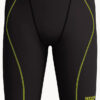
This is an adult men’s jammer, so it only suits older teenage boys who already fit adult sizes. Check the size chart carefully rather than assuming it fits. It’s made from 79% recycled nylon and 21% elastane with flatlock seams. The retailer listing describes dual-layer compression panels on the legs, a soft gripper waistband and World Aquatics approval. It’s an entry-level racing jammer, a sensible first step for a teen moving into bigger meets. Skip it for younger boys who still wear junior sizes. The listing also says it can’t be returned.
Sizing for a growing swimmer
The instinct to buy a size up so it lasts works against you with a tech suit. A suit that’s loose lets water in and gives no compression, so the swimmer pays for something that doesn’t do its job.
Fit for now. A correctly sized racing suit feels very snug, takes time to put on and shouldn’t leave gaps at the back, straps or leg openings. Sizing varies by brand and model, so use that brand’s size chart, and book a fitting if the retailer offers one.
Time the purchase. Buying a few weeks before a target meet, rather than at the start of a long season, means the suit is more likely to fit when it counts. Get your child into it for a short swim before race day so the tightness isn’t a surprise.
Caring for a junior tech suit
Good care is the easiest way to get more races out of the suit.
- Put it on slowly, using the pads of your fingers rather than nails, and ease the fabric up a little at a time.
- Wear it for racing, not training or warm-up sets.
- Rinse in cold fresh water straight after the session.
- Don’t wring it. Roll it in a towel to press out water.
- Dry it flat in the shade, away from heaters and direct sun.
- Keep it away from sunscreen, rough pool edges and the dryer.
Buying second-hand: the risks
Second-hand tech suits appear in club swap groups and online, and some are fine. The risk is that you can’t easily see how many races a suit has had. Compression fades well before visible wear appears.
Check the fabric for shine, thinning or loose threads, and look at the seams and leg grippers. Make sure the model is on the current World Aquatics approved list if your meet requires it. Ask for the size label and the brand’s size chart, because a used suit that doesn’t fit snugly isn’t worth having. Price it against a new training suit, not a new tech suit.
When to buy
If there’s no target meet coming up, there’s no rush. Retailers adjust prices from time to time, and we track prices daily, so you can keep an eye on the listings below without committing early. If a meet is close and the coach has said yes, a correct fit in time matters more than waiting.
The sensible default: a second good training suit
For most club swimmers, the better spend is a second chlorine-resistant training suit. Your child can rotate them so each one dries fully between sessions, and both last longer. You’ll find more options in our kids and junior swimwear section.

A girls’ training one-piece in Speedo’s Endurance+ fabric, made with 50% recycled materials. The retailer listing describes it as quick-drying and chlorine resistant, with a cut that allows good shoulder movement. It suits girls in squad training and club racing who need a hard-wearing everyday suit. Skip it if your daughter’s coach has already asked for a racing suit for a specific championship meet. This is a training suit, not a compression suit.

A boys’ training jammer in Endurance+ fabric with an internal drawcord waist and 50% recycled materials. The listing says it’s quick-drying and chlorine resistant. It suits boys training several times a week and racing at club level, where a secure waist matters more than compression. Skip it as a race suit for big meets once the coach has said a racing jammer is warranted.
Race-day goggles
Goggles that stay put off the dive often matter more than the suit for a young racer.
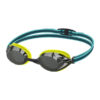
A junior racing and training goggle with mirrored lenses to cut glare, which helps in outdoor pools. The retailer listing describes a fully adjustable slide-and-lock nose bridge, wider flat straps and World Aquatics approval. It suits juniors who race regularly and have outgrown basic kids’ goggles. Skip it for younger beginners who are still learning to adjust a nose bridge, as a simpler one-piece goggle is easier for them.
At a glance
| Product | Type | Key specs | Suits | Currently from |
|---|---|---|---|---|
| Speedo Girls Fastskin LZR Ignite Kneeskin | Girls racing kneeskin | 75% nylon / 25% spandex; open back; listing says approved | State or regional racers, after a fitting | $399.99 |
| Speedo Men’s Fastskin Hyperspark Jammer | Adult racing jammer | 79% recycled nylon / 21% elastane; flatlock seams; listing says approved | Older teens in adult sizes | $129.99 |
| Speedo Girls Endurance+ Medalist | Girls training one-piece | Endurance+ fabric; 50% recycled; chlorine resistant per listing | Everyday squad training | $40 |
| Speedo Boys Endurance+ Jammer | Boys training jammer | Endurance+ fabric; internal drawcord; 50% recycled | Everyday squad training | $35 |
| Speedo Junior Vanquisher 3.0 Mirror | Junior racing goggle | Mirrored lenses; slide-and-lock nose bridge | Juniors racing regularly | $40 |
Frequently asked questions
At what age does a child need a tech suit?
Readiness matters more than age. Most swimmers don’t need one until they’re qualifying for state, regional or higher-level meets, and the coach is the best judge of when that is. Some associations also restrict tech suits for younger age groups, so check your state association’s current rules and the meet information before buying. Club-level racing in a good training suit is normal.
How do I size a junior tech suit?
Use the brand’s own size chart for that model, as sizing varies between brands and ranges. A racing suit should feel very snug, take a few minutes to get on and leave no gaps at the back, straps or legs. Don’t size up for growth, because a loose suit loses its compression. Book a fitting with a specialist retailer if you can.
How long does a junior tech suit last?
It depends on how often it’s raced in, how it’s cared for and how fast your child grows. Compression fabric loosens with use, so it’s best kept for key meets rather than training. Rinse it in cold fresh water, don’t wring it and dry it flat in the shade. For a growing child, fit often runs out before the fabric does.
Are junior tech suits worth it?
For a swimmer racing at state or regional level whose coach recommends one, a well-fitted tech suit can be a reasonable expense for key meets. For most club swimmers, it isn’t the best use of money yet. A second chlorine-resistant training suit and a reliable pair of goggles will usually do more for a developing swimmer.